Do Print Leggings Go See-Through? How to Tell Before You Buy
It is the question that stops most people buying printed leggings online, and it deserves a straight answer: yes, some printed leggings go sheer when you bend. No, it is not because they are printed. And yes, you can usually tell before you order.
Why leggings go sheer
Sheerness is a function of fabric weight and stretch, not decoration. When you squat, the fabric across the seat stretches in two directions at once. If there is not enough material to begin with, the yarns separate and light passes between them.
Three things decide whether that happens:
- Fabric weight. Measured in GSM — grams per square metre. Below about 200 GSM, most four-way-stretch knits will go sheer under tension. Around 240 to 280 GSM is where opacity becomes reliable.
- Knit density. Two fabrics at the same weight can behave differently depending on how tightly they are knitted.
- Fit. A legging stretched near its limit is thinner by definition. The same pair can be opaque on one body and sheer on another purely because of how far it has had to stretch.
Why print actually helps
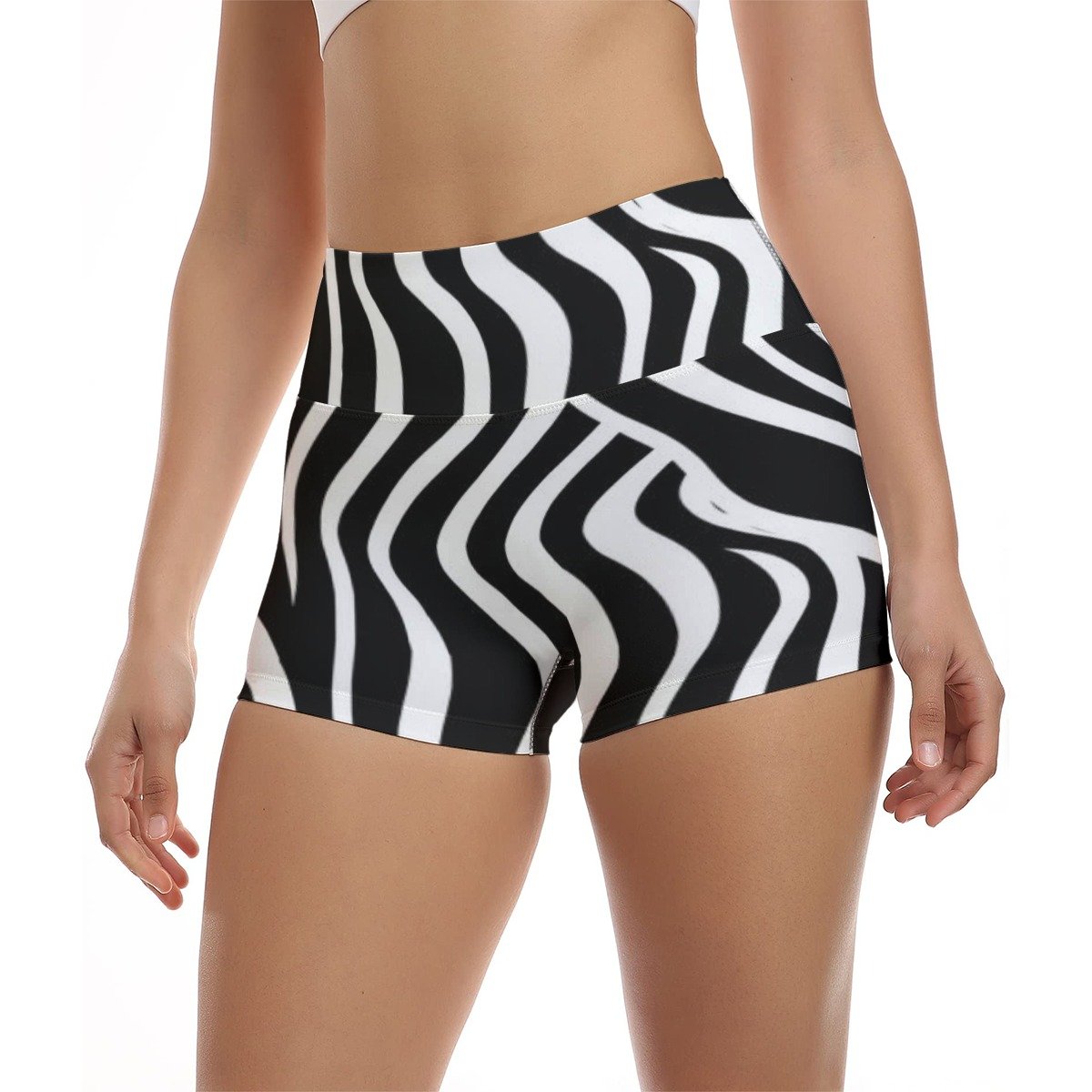
Here is the counterintuitive part. A busy all-over print is more forgiving than a flat black legging, because pattern breaks up the visual field. The eye reads texture and colour variation rather than a smooth surface where any thinning shows immediately.
This is why plain black leggings have the worst reputation for sheerness despite often being the same fabric. Nothing hides a thin patch like a dense print.
How to check before you buy
Look at the weight if it is listed
If a GSM figure is given, use it. Anything at or above 240 GSM is generally safe for squatting.
Check the waistband construction
A wide, doubled waistband is a sign the maker has spent money on the fabric. Thin single-layer waistbands usually sit on thin fabric.
Buy your real size, not your aspirational one
This is the biggest lever and the one people ignore. Sizing down makes any legging more sheer, because you are asking the same fabric to cover more area. Our guide to measuring yourself for clothes that run small exists for exactly this.
Consider the colour
Light grounds show more than dark ones at identical weight. If you are worried, start with a darker colourway.
The squat test, done properly
When your order arrives, put them on and squat in front of a mirror in daylight — not under a bathroom light, which flatters everything. Look at the seat and the outer thigh. If you can see skin tone rather than fabric colour, they are too sheer for training and you should tell us within seven days.
Do the test before you wear them out. It takes ten seconds and it settles the question permanently.
What we do about it
Everything in our activewear range is made to be worn in daylight, not just in a dim gym — which is the whole point of printing it in the first place. If a piece does not hold up to the squat test, that is a defect and we replace or refund it.
Questions we get
Do shorter styles go sheer less?
Generally yes, because there is less fabric under tension across a smaller area. Shorts are a lower-risk starting point if you are unsure.
Does washing make leggings more sheer?
Only if you are damaging the fibres. Hot washes and tumble drying break down elastane, which is what causes bagging and thinning over time. Cold wash, hang dry.
Is squat-proof a real standard?
No. It is a marketing term with no agreed definition or test behind it. Fabric weight and honest sizing are the only things that actually predict opacity.